



On a recent exchange in Japan, I asked other students what they thought makes for successful recycling after having experienced recycling programs in both the United States and Japan. Their answer wasn’t ideology or policy—it was habit: clear rules, a shared calendar, and social pressure to sort right. That simple strategy is exactly what we can all use.
Japan and the United States are both wealthy and innovative—and stuck with underperforming waste systems for opposite reasons. Japan’s culture of mottainai (“what a waste!”) and strict separation rules deliver high household compliance and tidy streets. But the country still burns about 80% of its municipal waste, often branding the energy as ‘thermal recycling.’ The U.S., by contrast, prizes convenience: one mixed ‘single-stream’ recycling cart, fragmented local rules, and a system that worked when global markets paid for our recyclables but faltered when they didn’t. The result is more landfilling, more contamination, and uneven participation across cities and states.
History explains a lot. Japan’s 1970 “Pollution Diet” and a suite of 3R laws (reduce-reuse-recycle) made producers responsible for packaging and appliances, and taught residents to sort by a tight rulebook. It works socially—neighbors expect you to follow the gomi (trash) calendar—even if public bins are scarce and rules can be burdensome. The U.S. landmark law (RCRA, 1976) cleaned up dumps but never mandated recycling or producer responsibility, leaving thousands of local programs to set their own rules. When China’s National Sword banned most scrap imports in 2018, U.S. recycling economics buckled.
Outcomes reflect the difference. Americans generate far more waste (~951 kg per person vs. ~326 kg in Japan). Japan collects and “recovers” more plastic—but much of it is burned for energy, not remade into new plastic. The U.S. collects less and landfills more, with methane from landfills a major climate problem. Neither model is a circular economy; each optimizes for different systems with different drawbacks.
Young people see the gap. In a small survey of Japanese students who’ve seen both systems, respondents reported high personal compliance yet skepticism that national policies are effective. Several noted that public-space recycling is so limited they carry items home to sort correctly—proof of strong social norms but also infrastructure friction.
In spite of failings in both systems, the big takeaway is that clear instructions beat pure convenience. When rules and labels are simple and consistent, fewer wrong items end up in the recycling. Social norms matter too: when neighbors expect you to sort right, most people do. But we can’t put everything onto residents. Meeting people halfway with side-by-side trash and recycling carts in public spaces is a must. Funding also shapes results: programs work better when companies share the cost of dealing with the packaging they sell (not just taxpayers). And yes, technologies help—optical scanners, AI-guided robots, and bottle-and-can return kiosks boost capture rates—but they work after the basics such as clear rules, steady funding, and public support are in place.
What you can do
- Buy fewer, better-made items;
- repair before replacing;
- rinse containers and keep plastic bags, cords, and other “tanglers” out of the recycling carts;
- skip “wish-cycling.” (Use the City’s Recycle Right Newton app to check what is recyclable or throw it in the trash if in doubt.);
- if a public bin is confusing, take the item home to sort correctly;hoose brands that publish recycled-content targets and offer real take-back programs.
Your cart and your wallet are votes. If enough of us in Newton use them well, Massachusetts can scale what works—clear rules, steady funding, smart tools—and skip what doesn’t.
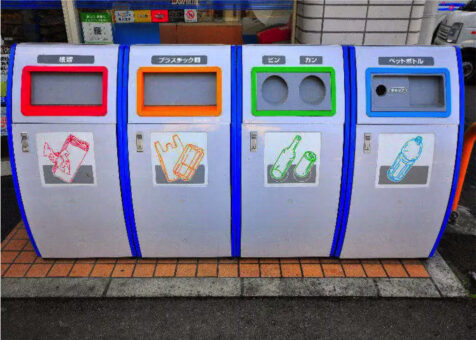
Color-coded recycling station at a Japanese convenience store—separate slots for burnable trash, plastic packaging, glass bottles, cans, and PET bottles. Clear labels cut guesswork.
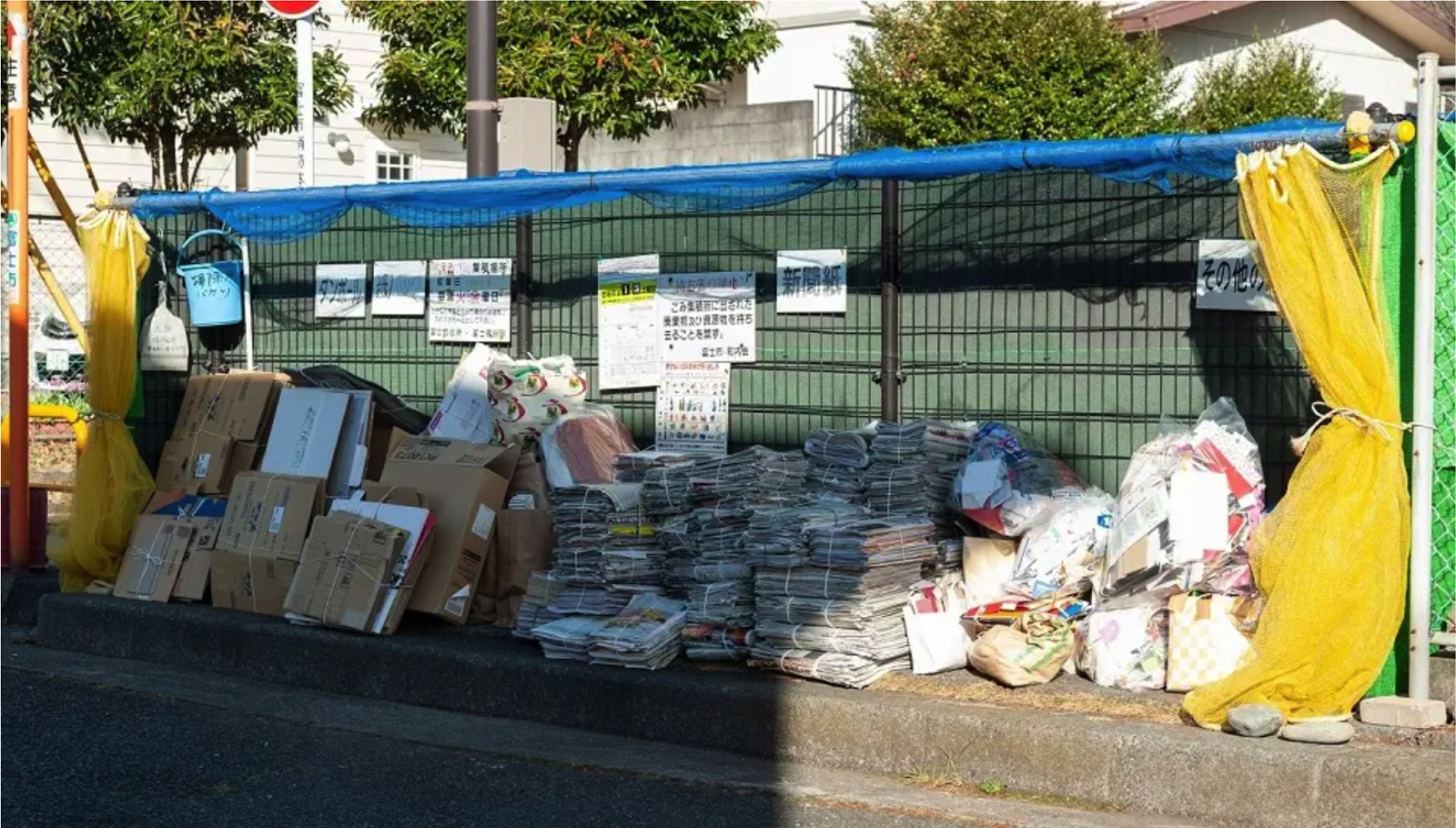
Neighborhood “gomi” collection point: neatly bundled cardboard and newspapers with pre-sorted bags, set out on scheduled pickup days under a mesh net to keep items contained.
Charles He is a rising senior at Milton Academy and a Green Newton intern. He’s an activist for Environmental wellbeing and hopes to study environmental engineering and policy in college.
Photo credits
Left photo: LIVE JAPAN – Shibuya — https://livejapan.com/en/in-tokyo/in-pref-tokyo/in-shibuya/article-a0002380/
Right photo: Ejable – Garbage Disposal in Japan — https://www.ejable.com/japan-corner/life-in-japan/garbage-disposal-in-japan/